The primary difference between these terms is that "moral" relates to individual ethics or conduct, while "morale" refers to the collective spirit and confidence of a group. Correct usage of moral vs morale ensures that a writer communicates intent with precision, whether discussing personal character or team dynamics. Because these words share a similar visual structure, they are frequently confused in professional and casual writing. Mastering the distinction is essential for clear communication.
SpellingSeptember 17, 2026
Moral vs. Morale: What Is the Difference?
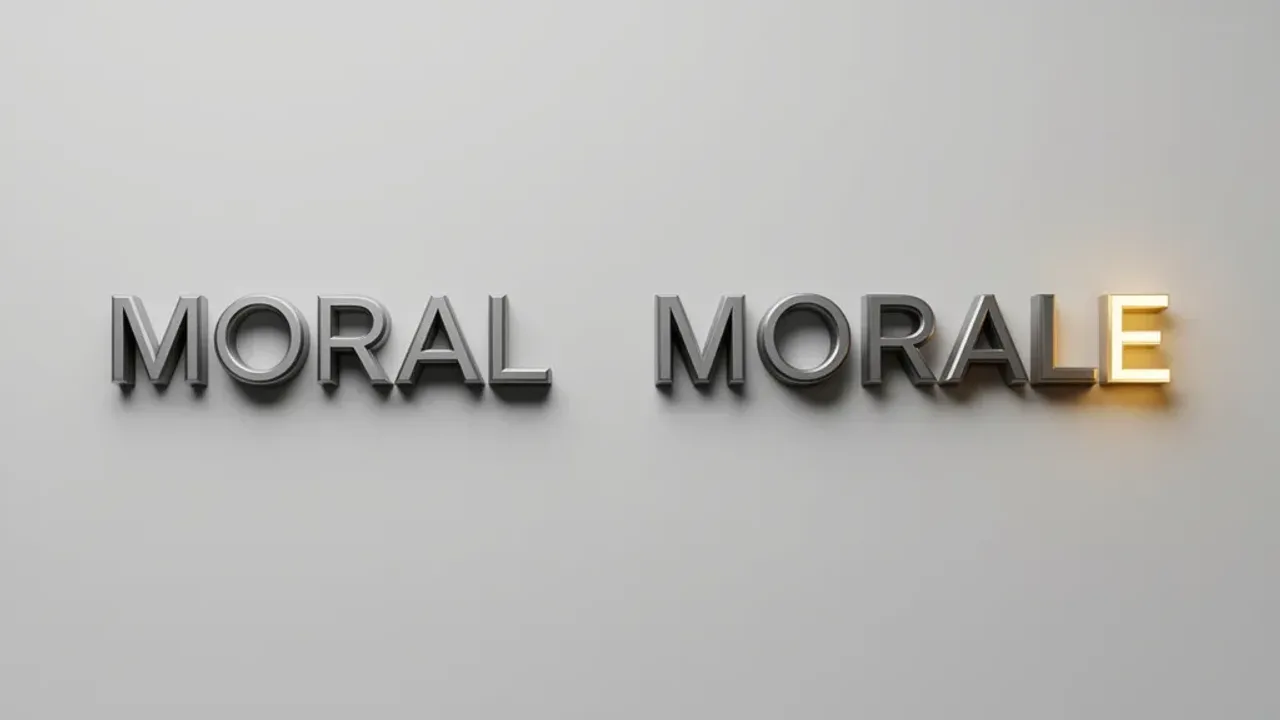 AI-generated image
Key Takeaways:
- Moral concerns ethical principles, whereas morale describes the collective mindset of a team.
- The word "moral" functions as both an adjective and a noun, while "morale" is exclusively a noun.
- People often confuse these terms due to their similar spelling, which differs by only one letter.
- Using the extra "e" in "morale" as a mnemonic for "enthusiasm" helps clarify the distinction.
| Feature | Moral | Morale |
|---|---|---|
| Primary Definition | Principles of right and wrong | Confidence and enthusiasm |
| Scope | Individual or personal | Collective or group-based |
| Part of Speech | Adjective or noun | Noun |
| Core Focus | Ethics and behavior | Mindset and discipline |
Understanding the Meaning of Moral
The word "moral" is highly versatile in the English language. As an adjective, it describes behavior that conforms to a standard of right and wrong. For example, a person might be described as having a strong moral compass, indicating that their actions are guided by a clear set of ethical values. It is a defining trait.
When used as a noun, "moral" refers to the lesson or conclusion drawn from a story, fable, or real-life experience. In literature, the moral of the story is the takeaway that highlights a virtuous path. Whether discussing personal integrity or the ethics of a specific decision, "moral" always centers on the individual’s relationship with rightness.
Understanding the Meaning of Morale
In contrast, "morale" is a noun that describes the emotional state, attitude, and level of confidence within a group or organization. It is not about one person's ethics but about the collective energy of a team. When a workplace or a military unit is performing well, people often say that their morale is high.
High morale is often linked to motivation and success. Conversely, low morale can lead to decreased productivity and a lack of enthusiasm. Because "morale" is exclusively a noun, it cannot be used to describe an individual's ethical choices. It is a term meant for collective spirit. It is vital to keep this distinction in mind.
When to Use Which
Selecting the correct term depends entirely on the scope of your sentence. If you are discussing the ethical qualities of a person or the lesson of a narrative, always use "moral." If you are discussing how a group of people feels, how motivated they are, or their overall level of discipline, "morale" is the precise term. Understanding moral vs morale is vital for professional communication.
- Assess the subject of the sentence: Is it an individual or a group?
- Identify the focus: Is it ethics or emotional energy?
- Choose "moral" for ethics and "morale" for group spirit.
- Proofread to ensure the final "e" is present in "morale."
Source of Confusion
The confusion between these terms arises from their visual similarity. They differ by only one letter. Because "moral" is a more common word, individuals frequently misspell "morale" by omitting the final "e." This orthographic proximity leads to errors in both professional and casual writing. It remains a persistent challenge for many writers.
Frequently Asked Questions
Is "moral" always an adjective?
No, "moral" functions as both an adjective and a noun. As an adjective, it describes ethical behavior. As a noun, it refers to the lesson of a story.
Can "morale" describe an individual?
Morale is typically applied to a group. It is rarely used for a single person. It measures the collective spirit of a team.
How can I remember the difference?
Associate the extra "e" at the end of "morale" with "enthusiasm." Since "morale" concerns group spirit, remembering the "e" for energy helps prevent misspelling.
Does "moral" have other meanings?
Beyond ethics, "moral" refers to the intended lesson of a story. It centers on the concept of rightness.
Why is "morale" frequently misspelled?
The base word "moral" is more frequent in daily usage. Writers often omit the distinguishing letter by mistake. This complicates the moral vs morale comparison.
To use these words correctly, remember that "moral" focuses on individual ethics, while "morale" describes collective spirit. Always include the final "e" when you intend to describe team enthusiasm.
Share: