A length of 5 centimeters is equal to 1.9685 inches. When someone asks how long is 5 cm, the answer consistently refers to a distance of 50 millimeters or 0.05 meters. This measurement serves as a fundamental reference point in the metric system, used globally for scientific, engineering, and everyday tasks. Understanding this length helps in visualizing scale, selecting the right tools, and ensuring precision in various projects.
MeasurementsNovember 18, 2026
How Long Is 5 cm? Conversion to Inches and Millimeters
 AI-generated image
Key Takeaways:
- Five centimeters is precisely 1.9685 inches.
- This measurement equals 50 millimeters.
- Use a calibrated ruler for accuracy.
- Metric units are the global standard.
Visualizing 5 Centimeters
Understanding this length is easier by comparing it to common items. A 5-centimeter segment represents a specific portion of the metric scale. Many individuals wonder how long is 5 cm when setting up equipment or working on small DIY tasks. It is quite small. This distance is roughly the width of two adult fingers held together.
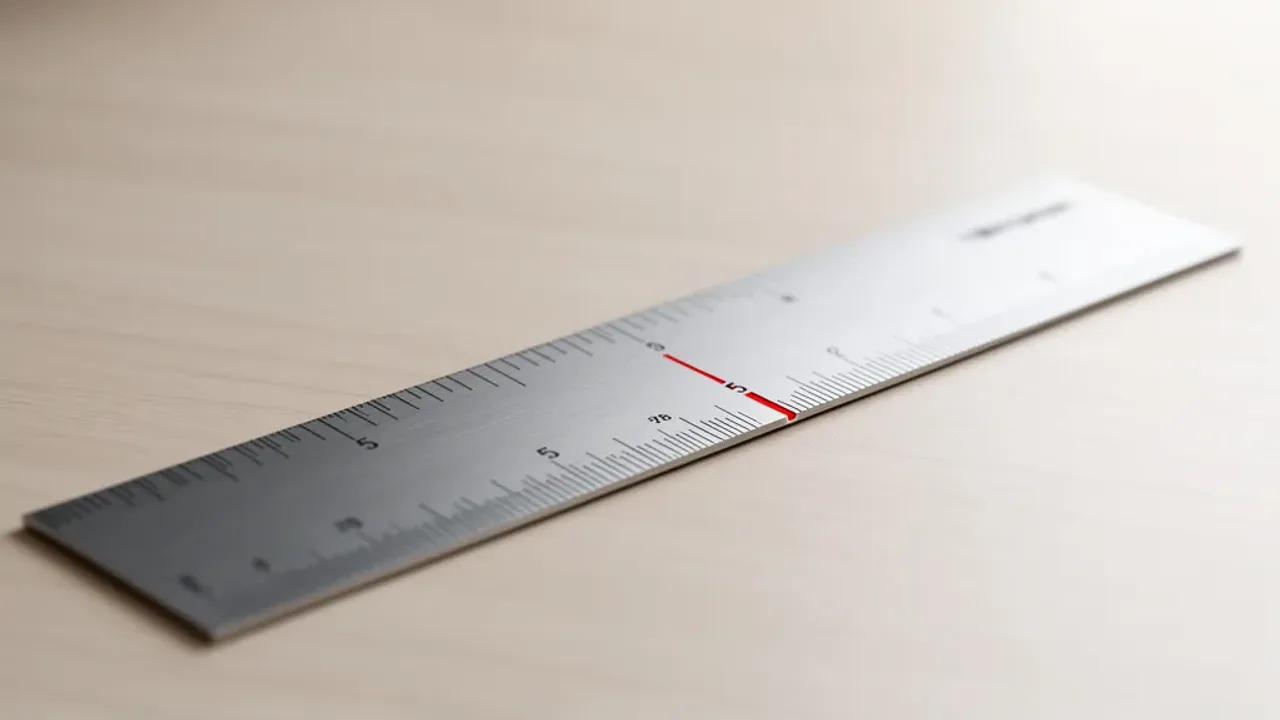
In a standard household setting, 5 centimeters often appears in various objects. For instance, the diameter of a large coin or the width of a standard smartphone bezel might approach this dimension. When you look at a metric ruler, the distance from the zero mark to the number five is exactly 5 centimeters. This span contains 50 individual millimeter marks, highlighting the precision inherent in the metric system.
Visualization is a powerful tool. By breaking down the centimeter into its smaller units, such as millimeters, one gains a better appreciation for the scale. Whether you are a student, a crafter, or an engineer, knowing how to identify 5 centimeters by sight can prove useful. It is a compact, manageable length that fits easily within most work environments.
| Unit | Measurement |
|---|---|
| Millimeters | 50 mm |
| Meters | 0.05 m |
| Inches | 1.9685 in |
| Feet | 0.164 ft |
Converting 5 Centimeters to Inches
Precision is necessary for technical tasks. When you need to convert metric lengths to imperial units, follow these steps to ensure accuracy:
- Verify your measuring tool is calibrated correctly at the start.
- Align the object precisely at the zero mark on the ruler.
- Observe the final mark where the object ends.
- Multiply the metric value by 0.3937 to determine the inch equivalent.
Keep your workspace clean. Use good lighting. When investigating how long is 5 cm, always prioritize using a calibrated instrument. This avoids manual errors. Accuracy matters here. If you are comparing units, remember that the conversion factor remains constant. A small deviation in alignment can lead to significant errors in larger projects, so take your time.
The Importance of the Metric System
The metric system, or International System of Units (SI), is the most widely used measurement standard in the world. It is based on the meter, from which the centimeter is derived. By defining 100 centimeters as 1 meter, the system creates a simple, decimal-based framework that makes calculations intuitive. This simplicity is why scientists and engineers prefer it.
Unlike imperial systems, which often rely on complex fractions or varying conversion factors, the metric system uses powers of ten. This makes scaling measurements up or down extremely fast. If you know that 5 centimeters is 0.05 meters, you can easily calculate that 50 centimeters is 0.5 meters. The logic is consistent across all scales.
Global trade and scientific collaboration rely on these standards. Without a common language of measurement, international projects would face insurmountable challenges. Whether you are manufacturing parts or cooking a meal, the reliability of the centimeter ensures that results remain consistent regardless of the location.
Practical Applications in Daily Life
You may encounter a 5-centimeter requirement more often than you expect. In office environments, this measurement is common for paper margins, document formatting, or the placement of desktop accessories. In the world of fashion, small adjustments to hems or straps often involve measurements in the 5-centimeter range.
For those interested in gardening, 5 centimeters is a standard depth for planting many types of seeds or bulbs. Using a small ruler to ensure this depth helps in achieving optimal growth conditions. Similarly, in construction or furniture assembly, knowing the exact length of a screw or a bracket is vital. A 5-centimeter fastener is a standard length for many medium-duty applications.
Even in technology, the size of components often follows metric standards. From the width of circuit board traces to the distance between mounting holes, 5 centimeters is a frequent benchmark. Being comfortable with this measurement allows you to navigate technical specifications with confidence and ease.
Frequently Asked Questions
How many millimeters are in 5 centimeters?
There are exactly 50 millimeters in 5 centimeters. Every single centimeter contains 10 millimeters. The conversion is easy, as you simply multiply by ten.
Is 5 centimeters the same as 2 inches?
It is slightly shorter. While 2 inches measures 5.08 centimeters, 5 centimeters is approximately 1.97 inches. It is a subtle difference that matters in high-precision work.
Why is the meter the base unit?
The meter is the international standard for length. It provides a consistent decimal-based system. Calculations become much simpler when using base-ten units.
Can I use a standard ruler?
Yes. A 30-centimeter ruler works perfectly. Most rulers clearly mark each millimeter. It is the most reliable tool for this task.
How does this compare to a foot?
Five centimeters equals 0.164 feet. This is a small fraction of a 12-inch foot ruler. It is a compact size for most handheld tools.
What is the easiest way to visualize 5 centimeters?
Think of the length of two fingers. Most adults have fingers that, when placed together, span roughly 5 centimeters. It is a handy, built-in reference.
To measure 5 centimeters, always align your object with the zero mark. This distance equals 50 millimeters or approximately 1.97 inches. Accuracy is always guaranteed by using a high-quality, calibrated metric ruler.
Share: