The primary difference between these terms is that "cubical" functions as an adjective describing a shape or geometric property, whereas "cubicle" is a noun identifying a specific, enclosed, or partitioned space. Understanding the distinction in cubical vs cubicle usage ensures precision in both technical and everyday communication. It is straightforward, yet often misunderstood.
SpellingAugust 23, 2026
Cubical vs. Cubicle: Key Differences in Meaning and Usage
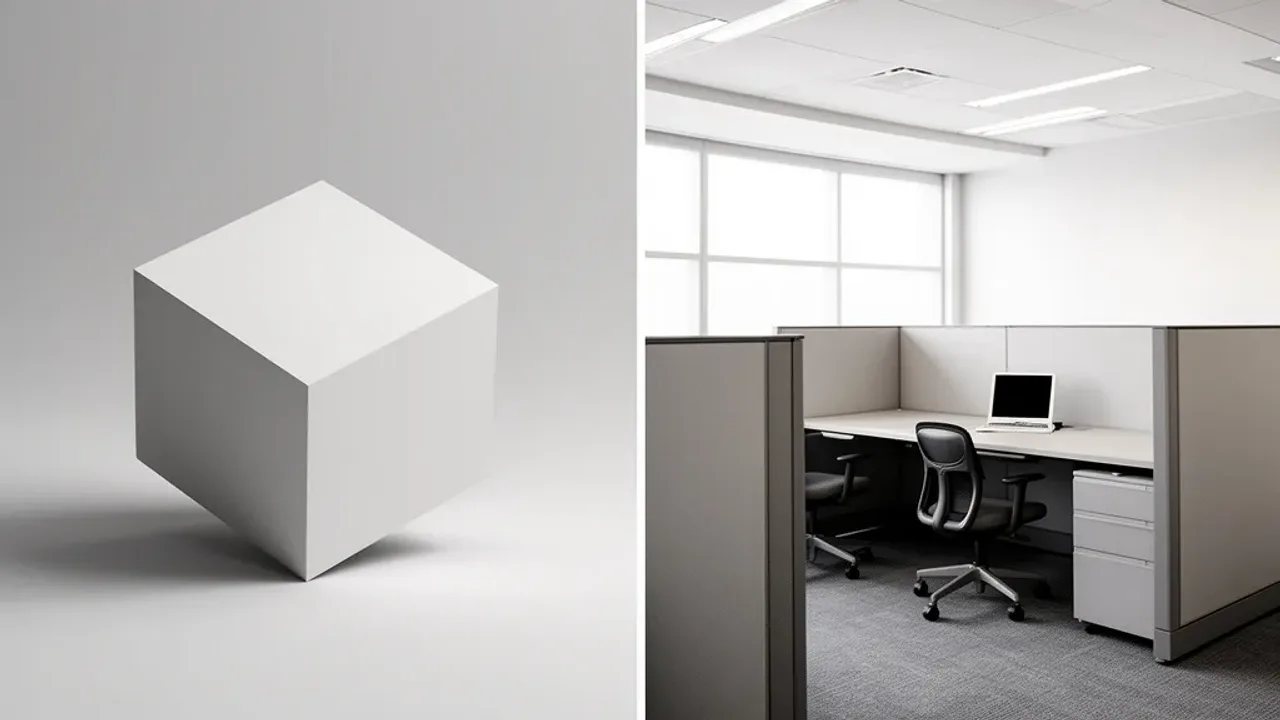 AI-generated image
Key Takeaways:
- "Cubical" is an adjective used to describe geometric shapes that resemble a cube.
- "Cubicle" is a noun referring to a small, partitioned-off area, commonly found in office environments.
- Always check your sentence structure to determine if you need a descriptive word or a noun.
- The suffix "-al" identifies the adjective, while "-le" typically marks the noun.
Language is a tool, and using the correct word for the correct context is essential for professional clarity. When we communicate about physical objects or architectural layouts, precision prevents confusion. This guide breaks down the nuances between these two similar-sounding words to help you choose the right one every time.
| Feature | Cubical | Cubicle |
|---|---|---|
| Grammatical Role | Adjective | Noun |
| Core Meaning | Having the form of a cube | A small, enclosed station |
| Context | Geometry, mathematics, physics | Office design, architecture |
| Example | A cubical box | An office cubicle |
When to Use Which
Reach for "cubical" whenever you describe the physical dimensions or structural properties of an object. For instance, if a container has equal length, width, and height, it is cubical in shape. Words matter. When you talk about abstract geometric properties, "cubical" is the term that conveys the mathematical essence of an object.
Conversely, use "cubicle" when identifying a location within an office or a private stall. This term designates a specific area designed for individual tasks, storage, or privacy. It is a physical noun, a place you can sit or store items. Correct usage prevents confusion between abstract geometric concepts and physical workspaces. If you are describing a place, stick with the noun.
Consider the difference in application. You might measure the volume of a cubical tank, but you would walk into a cubicle to start your workday. The distinction is functional. One describes how something looks, while the other describes what something is.
Why These Words Are Confused
The confusion between these terms arises from their shared root, "cube," and their similar visual appearance. Since both words share a nearly identical prefix, writers often substitute one for the other. Mastering the cubical vs cubicle comparison requires focusing on a clear checklist. It is quite simple.
The English language frequently uses suffixes to denote the part of speech. The "-al" suffix is a hallmark of adjectives. Think of words like "physical," "logical," or "chemical." They all describe states or qualities. In contrast, the "-le" suffix is common in nouns, particularly those that denote small versions of things or specific tools and locations. Recognizing these patterns makes it easier to remember which word to use.
- Determine if the word is modifying another noun (use cubical).
- Determine if the word acts as the subject or object of the sentence (use cubicle).
- Assess if you are discussing shape or space.
- Use "cubical" to describe a box.
- Use "cubicle" to describe your workstation.
- Replace the word with "boxy" or "enclosure" to test the fit.
If you are still unsure, try this simple test. Can you put the word "very" in front of it? "The box is very cubical" makes grammatical sense. "The box is very cubicle" does not. This is a classic trick for identifying adjectives versus nouns. Because these terms serve distinct grammatical purposes, recognizing the difference is vital for clarity. Adjectives modify nouns, while nouns represent entities. Use them wisely.
Frequently Asked Questions
Can I use "cubical" to describe an office space?
No. "Cubical" is an adjective and cannot function as the object of a sentence. Always use the noun "cubicle" when you are referring to an office workstation.
Is "cubicle" ever used as an adjective?
No. "Cubicle" is strictly a noun. If you need to describe something related to one, use it as an attributive noun, such as "cubicle wall" or "cubicle desk."
Are these words interchangeable in technical writing?
No. They represent different parts of speech and have different semantic meanings. Incorrect usage causes ambiguity and makes writing appear unprofessional.
Why do these words look so similar?
They share the root word "cube," which provides the base for both terms. The different suffixes, "-al" and "-le," define their unique grammatical functions in English sentences.
What is the easiest way to remember the difference?
Remember that "cubical" ends in "-al" like "adjective," while "cubicle" ends in "-le" like "location." This mnemonic helps keep the grammatical roles clear in your mind.
Always use "cubical" to describe a shape and "cubicle" to identify a partitioned workspace. The adjective form ends in "-al," while the noun form ends in "-le" to maintain accuracy.
Share: