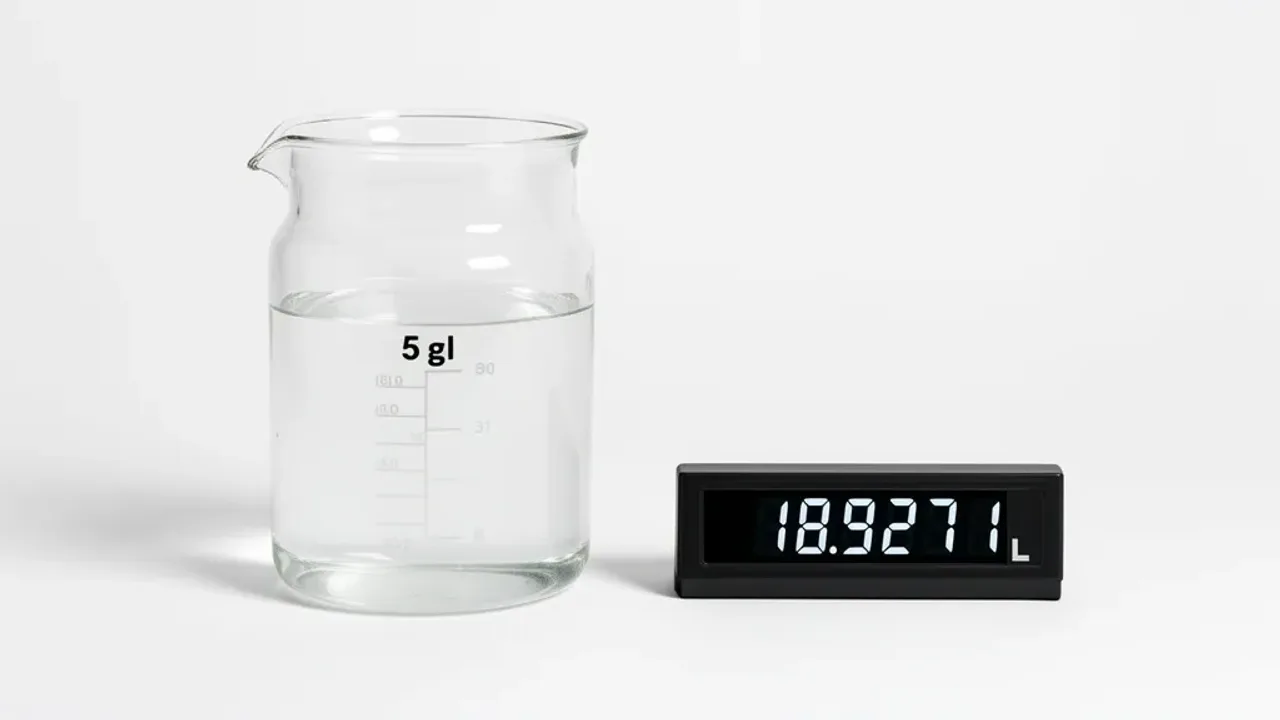
Five US liquid gallons are equal to 18.9271 liters. Understanding this conversion factor is essential for anyone needing to bridge the gap between US customary units and the international metric system. Whether you are working on a precise engineering project, handling industrial fuel volumes, or simply managing household liquids, knowing how these units relate allows for seamless data transitions.
ConvertersSeptember 2, 2026
5 Gallons to Liters: Conversion to 18.9271 Liters
 AI-generated image
Key Takeaways:
- Five US gallons convert exactly to 18.9271 liters.
- The standard conversion multiplier for one US liquid gallon is 3.78541.
- Always verify the specific gallon type, as imperial gallons differ from US liquid gallons.
- Mathematical precision is vital when calibrating equipment for different measurement systems.
Conversion Formula and Methodology
To convert US gallons to liters, you must multiply the volume value by the constant factor of 3.78541. Since one US liquid gallon is defined as 3.78541 liters, multiplying this figure by five results in the total of 18.9271 liters. This mathematical relationship remains the gold standard for all liquid measurements across the United States. It is a simple process. Precision is our goal.
When performing the calculation for 5 gallons to liters, you should follow these steps to ensure total accuracy in your work:
- Identify the total volume in US liquid gallons.
- Apply the specific multiplier of 3.78541 to the gallon value.
- Verify the result against a standard conversion table to confirm the metric volume.
| US Gallons | Liters |
|---|---|
| 1 gallon | 3.78541 liters |
| 2 gallons | 7.57082 liters |
| 5 gallons | 18.9271 liters |
| 10 gallons | 37.8541 liters |
| 20 gallons | 75.7082 liters |
Practical Applications in Daily Life
Accurate volume conversion is a foundational skill in many professional and personal environments. From automotive maintenance to large-scale liquid storage, knowing how to interpret volume data is critical. When you understand how to convert 5 gallons to liters, you gain control over your resources. It helps in avoiding errors. Proper calibration of your containers ensures that you are always working with the right amount of material, regardless of which measurement system your supplier or equipment manufacturer prefers to use.
- Check labels on imported containers to identify if they use US or imperial units.
- Ensure digital measurement tools are set to the correct regional standard.
- Use the 3.78541 constant to maintain consistency across technical documentation.
Frequently Asked Questions
Is the conversion the same for imperial gallons?
No. The conversion differs because the imperial gallon is a distinct unit of measure compared to the US liquid gallon. An imperial gallon is approximately 4.54609 liters, which will produce a significantly different result than the US liquid gallon calculation.
Why is the conversion factor 3.78541 used?
This specific number serves as the internationally recognized standard for converting one US liquid gallon to liters. It provides the necessary precision for accurate volume measurements in scientific, commercial, and engineering settings.
How do I convert liters back to gallons?
To convert liters to US liquid gallons, you divide the number of liters by 3.78541. This inverse operation will return the equivalent volume in US gallons accurately.
Are there different types of US gallons?
Yes. The US liquid gallon used for fluid measurement differs from the US dry gallon, which is used for measuring dry bulk commodities. When performing conversions, always ensure the unit type matches the intended application to avoid errors.
Can I use a rounded number for quick estimates?
While 3.79 is often used for casual estimation, 3.78541 is required for industrial or scientific accuracy. Using the full constant prevents cumulative errors in large-scale calculations. Accuracy is always preferred.
Summary
Five US gallons equal exactly 18.9271 liters. Always use the 3.78541 multiplier to ensure precise results in your volume measurements.
Share: